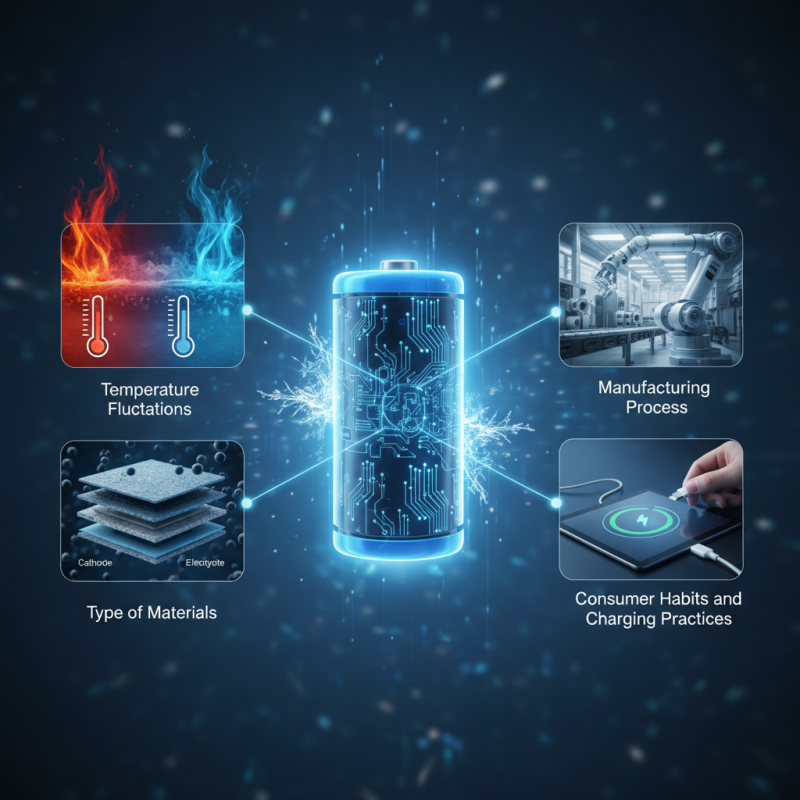
In today’s rapidly advancing technology landscape, understanding what factors affect battery performance is crucial. As China's battery market grows, several elements influence the efficiency and longevity of these power sources. For instance, temperature fluctuations can significantly impact battery life. Extreme heat can cause overheating, while cold conditions may reduce performance.
Moreover, the type of materials used in battery production also plays an essential role. Lithium-ion batteries, for example, are widely known for their energy density but may have limitations regarding recharge cycles. The manufacturing process itself can introduce variations, affecting durability and efficiency.
Lastly, consumer habits and charging practices should not be overlooked. Poor charging routines can lead to diminished battery life over time. Reflecting on these factors can guide better choices for both manufacturers and users alike. Understanding the nuances of battery performance is key to fostering a sustainable energy future.
Key Characteristics of Top Battery Technologies in China
Battery performance is critical for various applications, especially in electric vehicles and portable electronics. In China, the leading battery technologies showcase impressive characteristics that influence their effectiveness. Lithium-ion batteries dominate the market, accounting for nearly 80% of the total battery use in electric vehicles according to the China Automotive Technology and Research Center. Their energy density allows for longer driving ranges, vital for consumer satisfaction.
Another notable technology involves solid-state batteries. These batteries have a higher safety profile and can potentially double the energy density compared to conventional lithium-ion batteries. Research from the National Renewable Energy Laboratory indicates that solid-state batteries are projected to reach commercial viability by 2025. However, manufacturing challenges remain. For instance, scaling up production while maintaining quality is an ongoing issue.
Additionally, fast-charging capabilities are essential. Current lithium-ion technologies can charge to 80% capacity in under 30 minutes, but industry goals suggest faster options. While some prototypes claim to achieve this, reliability is still in question. The ongoing exploration of silicon anodes could present transformative improvements. However, the industry must reflect on cost management and supply chain complexities that affect these advancements.
Influence of Material Composition on Battery Efficiency
The battery performance of top products in China is notably influenced by
material composition.
Lithium-ion batteries dominate this market. The choice of materials
directly affects energy density,
lifespan, and
charging times. For instance, variations in
electrolyte composition can lead to significant differences
in efficiency. Effective electrolytes enhance ion mobility, improving overall performance.
Moreover, the cathode and anode materials
play critical roles. Common materials include
cobalt,
nickel, and
graphite. Each presents unique benefits and challenges.
Cobalt, for instance, boosts energy density but raises ethical concerns due to mining practices. Meanwhile,
alternatives like
lithium iron phosphate offer safety but at lower
energy output.
Manufacturers face a trade-off. They must balance
performance with sustainability. The quest for innovations often leads to unreliable experiments. New
materials may promise higher efficiency but can result in performance issues.
Continuous research and development are essential to
address these challenges effectively. The industry must remain vigilant in its approach to material selection and
performance optimization.
Environmental Conditions Affecting Battery Performance
Environmental conditions significantly influence battery performance, particularly in China's varying climates. Temperature fluctuations lead to diverse impacts on battery efficiency. Research indicates that in extreme heat, battery life can reduce up to 20%, while cold conditions can hinder performance by around 15%. This shows how crucial it is to consider local climates when assessing battery technology.
Humidity also plays a key role in battery performance. High humidity levels can increase the risk of corrosion, affecting the longevity and safety of batteries. The National Renewable Energy Laboratory reports that moderate humidity can enhance conductivity, but excessive moisture introduces risks. Therefore, managing environmental factors is essential to ensure optimal battery functionality.
Furthermore, air quality and pollution can affect battery materials and overall lifespan. Pollutants may interact negatively with battery components. A case study showed that batteries in urban areas with high pollution levels exhibited a 10% drop in capacity. These variables highlight the importance of environmental awareness in battery technology, encouraging further research.
Role of Manufacturing Processes in Battery Quality
Battery performance is highly influenced by manufacturing processes. The quality of materials, precision in assembly, and environmental conditions play critical roles. Poor manufacturing can lead to defects that diminish efficiency and safety. For example, a tiny error in cell alignment can result in energy loss. Ensuring quality control is essential for top products in the market.
Tips: Always check for certifications that indicate rigorous testing and quality standards. Understanding the manufacturing process can reveal much about a battery's expected performance.
Environmental factors like temperature and humidity also matter. These conditions can affect the chemical reactions within batteries. High temperatures might lead to quicker degradation, while humidity can cause corrosion. Many manufacturers overlook these factors, which can impact long-term reliability.
Tips: Store batteries in stable environments. Avoid extreme temperatures and excessive moisture to prolong life.
Investing in refined production techniques is crucial. With advancements in technology, process optimization can lead to impressive improvements. However, continuous monitoring is needed to maintain standards. Understanding these facets is vital for anyone interested in battery-dependent technologies.
What Factors Impact Battery Performance in China Top Products? - Role of Manufacturing Processes in Battery Quality
| Battery Type |
Capacity (mAh) |
Cycle Life |
Temperature Range (°C) |
Manufacturing Process |
| Lithium-Ion |
3000 |
500 |
-20 to 60 |
Roll-to-Roll |
| Lead-Acid |
1200 |
300 |
0 to 40 |
Batch Processing |
| Nickel-Cadmium |
1500 |
1000 |
-20 to 50 |
Continuous Casting |
| Lithium Polymer |
2000 |
400 |
-20 to 60 |
Film Casting |
| Sodium-Ion |
2500 |
600 |
0 to 50 |
Eco-friendly Synthesis |
Market Demand and Innovation Driving Battery Development in China
The battery market in China is witnessing rapid transformation, driven by innovation and market demand. A recent report from the China Battery Industry Association noted that battery capacity in electric vehicles (EVs) has increased by 20% in just one year. This surge reflects the need for longer-range vehicles to meet consumer expectations. Moreover, the production of lithium-ion batteries has grown by over 30%, indicating a robust response to market needs.
Innovation plays a key role in battery performance. New materials and technologies are being researched extensively. According to a statistics release from the Ministry of Industry and Information Technology, R&D investment in battery technology has reached nearly ¥10 billion. Despite progress, challenges remain. Many companies struggle with scalability and production costs. The balancing act of enhancing performance while reducing expenses is an ongoing issue.
As demand rises, the pressure is on manufacturers to improve efficiency and sustainability. The International Energy Agency projects that by 2025, global battery demand could triple. This shift requires not only technological advancement but also a reconsideration of supply chains and resource management. Striking the right balance between innovation and feasibility will be critical for the future of battery performance in China.
FAQS
: Leading battery technologies in China include high energy density, safety profiles, and fast-charging capabilities.
Lithium-ion batteries dominate due to their energy density, offering longer driving ranges that enhance consumer satisfaction.
Solid-state batteries can double energy density compared to lithium-ion. They are safer but face manufacturing challenges.
Current technologies can charge to 80% in under 30 minutes, although faster options are being researched.
Quality of materials and precision in assembly are crucial. Poor manufacturing can cause defects, affecting efficiency.
High temperatures may lead to degradation, and humidity can cause corrosion. These factors affect long-term reliability.
Quality control helps prevent defects that can diminish efficiency and safety, essential for high-performing products.
Look for certifications that show rigorous testing and standards in the manufacturing process.
Refinements can lead to better performance and reliability, but continuous monitoring is needed to uphold standards.
Challenges include cost management and supply chain complexities that can hinder progress in battery advancements.
Conclusion
The performance of batteries in China's leading products is influenced by several critical factors. Key characteristics of top battery technologies include advancements in energy density and charge cycles, which significantly enhance efficiency. Additionally, the influence of material composition plays a crucial role, as the choice of materials directly affects the overall battery efficiency and longevity.
Environmental conditions, such as temperature and humidity, further impact battery performance, highlighting the importance of operating environments. Moreover, the manufacturing processes employed also determine battery quality, ensuring consistency and reliability across products. Lastly, market demand and ongoing innovation drive the development of new technologies, reinforcing the need for continuous improvement. Understanding what factors affect battery performance is essential for optimizing these systems and meeting consumer expectations in the competitive landscape.

 Autrionyx Power